by Julie Brewer MSc
Play whether with other dogs or people is a highly valuable experience and far more important than some may think.
Play develops and allows the practice of physical, cognitive, emotional and social skills.
Playing with People and Dogs
Puppies begin playing with their littermates as soon as their eyes open, sluggishly stumbling over one another in what looks like purposeful movement. Play is intrinsically reinforcing releasing happy hormones into the brain.
Dealing with negative experiences in the context of safe interactions.
Play often leads to mistakes, where the pup might experience discomfort or even pain, but if the majority of the play is rewarding then that negative experience will be over-ridden and become less influential to the pups feelings in the future.
Testing outcomes and Investigating options
Play allows the pup to try different ways of behaving, to find their preferred outcomes. It is a learning experience and these allow the development of cognitive skills which will increase learning potential in the future. This also allows the dog to experience different levels of arousal, activation of the fight or flight system and learn to have thoughtful control over their own actions.
Conflict Resolution
During play it is common to make mistakes and upset your play partner. If the pup can learn how to talk the other dog into restarting and continuing the game then they get to continue playing. But if the pup loses their temper the other dog is unlikely to want to continue the interaction or may even stop the game abruptly with an aggressive outburst.
Learning to read another dogs body language
By interacting with many different dogs the pup will start to recognise the common meta-signals given which indicate the other dogs willingness to start, continue carefully or stop the game.
Learning to communicate with others
Part of understanding another’s language is learning how to speak it yourself, how to position your body, when to pull a certain face, recognising the responses and responding appropriately. This cannot be practiced without exposure, and will not be practiced well with restriction, such as when on a lead. This is achieved by role playing, taking it in turns to be the aggressor or the subject of the aggression. Pretending to be aggressive might prevent injury in the future. Communication skills help to build social cohesion which is especially important when regularly being exposed to multiple dog environments.
Fun
Play should be fun. The rewarding chemistry produced when interacting in a fun way will help the dog to deal with those interactions which are less pleasant, and buffer them against learning that all dogs are unpleasant to be around.
Forming friendships
Just like people dogs will learn who they enjoy being with, who is good at playing in the style that they prefer. Often those early experiences will result in strong bonds and friendships which are resilient to negative interactions. They can learn to ignore those whose play style does not fit their own.
Physical Confidence
Play can be wild and rambunctious involving often acrobatic manoeuvres, this offers the pup an opportunity to learn how to leap and land safely, they are learning how to move their bodies to keep themselves safe, strengthening muscles and ligaments which will protect their joints into the future. Physical confidence is strongly linked to emotional confidence and mental stability which is important for both puppies and older dogs.
Letting off steam
Energy expenditure in play can result in a dog who is able to be calmer. Learning to take breaks during play will help the pup learn to self regulate in the future.
Practicing future behaviours
Mating and fighting behaviours are practiced during play, this is the effect of the dogs genetic history since being able to protect yourself and pass on your genetic inheritance is important. A puppy who is acting this way is not necessarily going to be aggressive or a sex pest when they are older, this is a natural part of learning to be a dog.
Playing Alone
Investigative Play
Dogs learn by doing. Object play allows the practice of so many skills, how to manipulate and dissemble objects, how to place their paws to restrain the object and how to use your tongue and teeth. Investigating many different sizes, shapes and textures of objects aids cognitive development as well as being fun solving problems. Overcoming challenges is very rewarding and helps the pup learn to go towards other new experiences confidently.

Scent Discrimination
Learning which smells lead to the best tastes, or you favourite toy, or your special person is first practiced as a part of play.
Owner Concerns
Is he learning to be bad?

While it is true that behaviours which are practiced can become habits or reflex responses, not allowing play will the restrict the potential benefits of doing so. By carefully monitoring our puppies play experiences we can help them to get all of the benefits without the potential downsides.
Is he learning to be destructive?
Make sure that the objects which your puppy can access are safe, and see how they interact with each new object. If you have a puppy who loves ripping or chewing things up make sure that the objects are either safe to swallow or indestructible. Do not allow them to access things which you value. Build a strong preference for those object which you give them by allowing them to find out how much fun they are. If you find that your pup always targets a specific “forbidden” object then imagine what they are seeking from that object, it might be that they’ve learned they can always get your attention that way. It is however more likely that the way the object feels, sounds, smells, moves or breaks (ripping, crunching, cracking) or tastes. It is important that while making your valuables unavailable, you provide a good alternative which provides similar sensations.
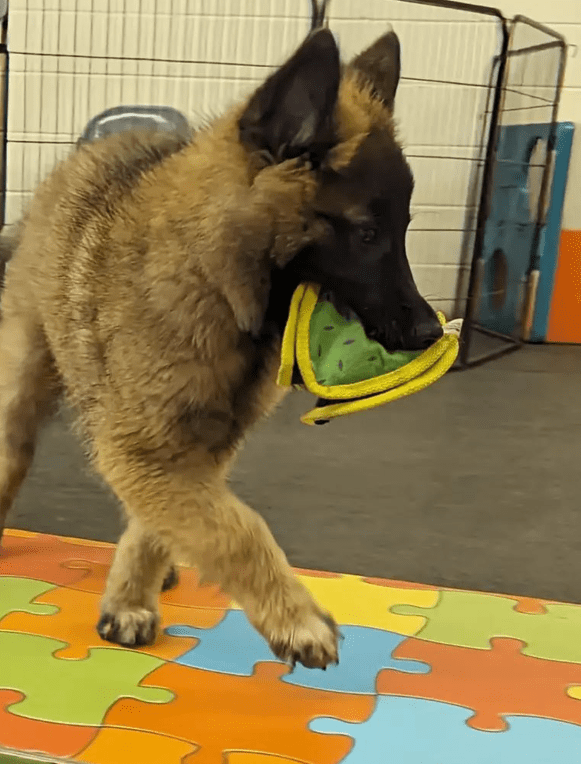
With You
Make sure that you are giving feedback constantly. If the puppy gets over excited and hurts you then stop playing immediately, if they continue to bite or jump at you remove yourself so that they cannot force you to respond, step out of the room if necessary. Do not say or do anything else with them until they are calmer. Puppies often misinterpret our attempts to calm them down, if we are touching them and speaking to them they can assume that we are still playing. If we get rough or angry then we risk scaring them which will damage our relationship. Make playing with you the best thing ever, and then if they do something you don’t like remove yourself from the game. The pup will quickly learn to control their temper and be more careful with their actions in order to keep you in the game. Remember though that puppies are more likely to lose their temper when they are tired, hungry or need the toilet.

With Dogs
Firstly we do not want our dogs to learn to expect to play with every dog that they meet. Learning to be around other dogs without playing is very important too. But when we do let them play how do we know that the play is ok?
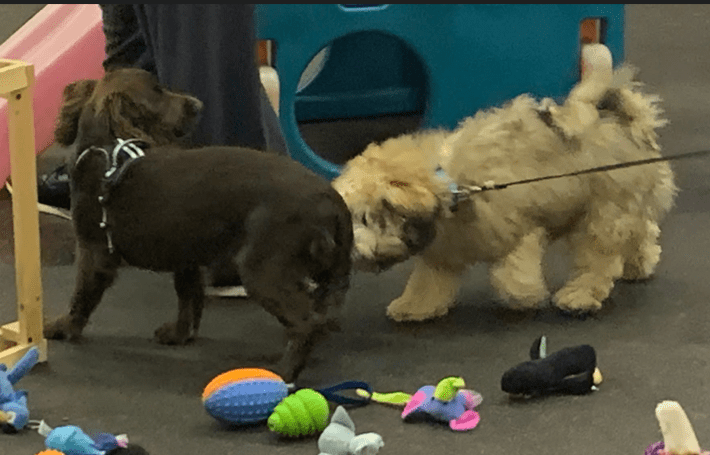
Good Play Signs
Stopping and taking mini breaks during play, this should be frequent, although it might be only for a split second, both dogs should stop what they are doing and then see whether the other dog wants to continue.
Using meta-signals, such as a “play face”, curving body, raising paws, loose dancing movements to let the other dog know that they are still interested in continuing the game.

Role changing e.g. taking it in turns to be the one on top, or the one who is chasing.
Self handicapping, i.e. throwing yourself on the floor so that the other dog can jump on you, or holding your punches so that the other dog can feel safe to play with you, especially important when big dogs play with small ones e.g. adults and puppies.
Shake off, this is where both dogs stop and shake as if they are wet.
Mouthing and play biting without causing any signs of discomfort or fear in your partner.
Vocalising, good play is exciting and often dogs who are really enjoying the game will growl, the “play growl” has a modulating tone, it goes up and down and sounds a bit like chatter.
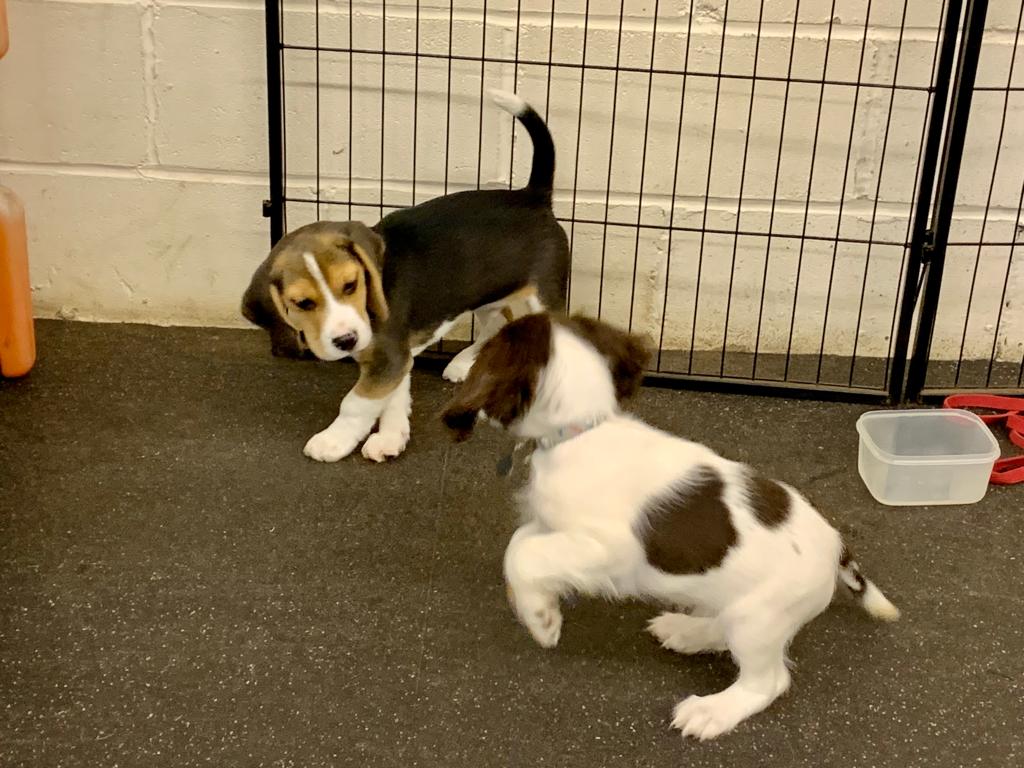
Inappropriate Play Signs
Neck biting and holding or pinning, this should be interrupted immediately and the offender removed from play until they are calmer, once they are reintroduced they should be monitored closely.
Big dogs playing rough with small dogs, even if both dogs are really enjoying the game there is a risk of injury. This is not something that we want to see.
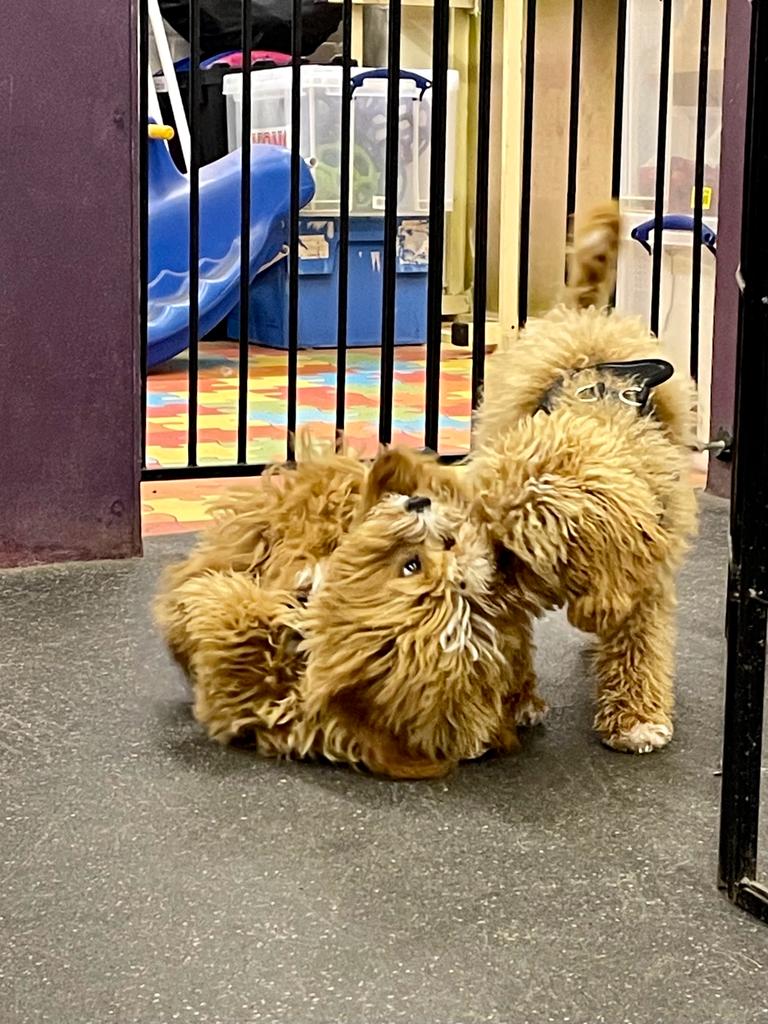
Getting over excited, when the arousal levels become too high there is a greater risk of things going wrong. It is better to stop the play regularly and give the dogs a break doing something calmer e.g. chewing before allowing them to spend time together again.
Knocking other dogs over by slamming into them, this is a big no no. It will lead to another dog really getting angry at some point in the future and could well result in a fight and injuries.
Pinning another dog down, sometimes this will happen in normal play, but if one dog keeps pinning another or not allowing them to get up then it should be stopped from playing immediately.
Putting your head over the neck or shoulders of another dog. This is a very rude behaviour which will lead to other dogs getting angry.
Growling or baring teeth. A nasty growl in monotonal, one deep long sound, the growl is not a bad thing, neither is showing the other dog your teeth. These are both warning signals that whatever the other dog is doing right now is not appreciated and should stop immediately. It is definitely a sign that the game should stop.
Barking in the face of another dog. This is rude and pushy behaviour. It is caused by frustration because the other dog is refusing to move or play. If the other dog doesn’t want to play then the game should stop.

Bad Play Signs
These are behaviours which might lead to problems in the future and should not be allowed to continue or be practiced.
Continuously chasing or pestering when the other dog has given signals of wanting to stop, e.g. going still or stiff, running away with tail tucked or hiding.
When rough play becomes too much for the partner but signals to calm down are ignored e.g. turning away, looking away, sniffing the ground, moving away.
Bullying, e.g. going after the same dog to push, pin, grab or bite them.
Hiding or backing away, this is a dog who is trying there best to remove themselves from the situation, if they are not helped then they might learn to use aggression to make the other dog move away from them.
If you think you need help with your dogs play style then get in touch with us or book a free telephone call via https://LittleTykesDogHub.as.me/
Julie Brewer MSc CAB, Dip.CABT, Cert TD
 LITTLE TYKES DOG HUB
Excellent advice!
Sent from Outlook for Androidhttps://aka.ms/AAb9ysg ________________________________
LikeLike