by Julie Brewer MSc Clinical Animal Behaviour, Pre-Cert CCAB, Dip. CABT (COAPE)
The secure base model provides a positive framework for caregiving which helps infants, children, and young people to move towards greater security and builds resilience. This model can be adapted for puppies by focusing on the interactions that occur between the owner and the puppy on a day to day, minute by minute basis within multiple environments including the home. The secure base model considers how the relationship between the owner and the puppy can help the puppy to develop competence in the outside world in their social interactions and decision making. It helps us to consider the owner and puppies interactions as having potential to shape the emotional, cognitive, and eventually the behavioural responses of the puppy.
This process begins with the puppy’s needs and behaviour and then focuses on what is going on in the mind of the owner. How an owner thinks and feels about a puppy’s needs and behaviour will determine the owners’ behaviour towards the puppy. An owner may draw on their own ideas about what puppies need or what makes a good dog owner from their own experiences or from what they have learned from previous training. The owner’s behaviour will convey certain information to the puppy. The way that the puppy feels about the world, other people and dogs will be affected by these messages and there will be an impact on the puppy’s development and future skills in managing social interactions.
The caregiving cycle shows the inter-connectedness of the owner/dog mind and behaviour as well as their ongoing movement and change.
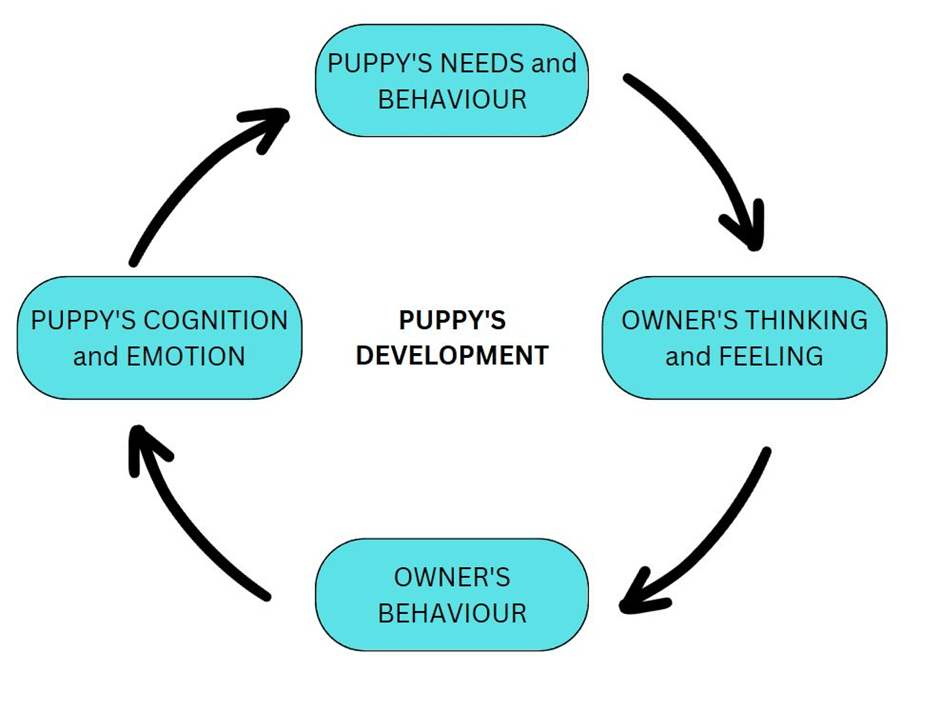
The caregiving cycle encompasses the minute-by-minute interactions between the dog’s owner/family/strangers and other dogs. These may involve managing major emotional or behavioural crises. Each interaction conveys a number of messages to the puppy and has an incremental effect on the pup’s emotional stability and ways of dealing with emotional challenges in the future.
For the purposes of the secure base model, we have grouped these owner/puppy interactions into five dimensions.
The first four dimensions are drawn from attachment theory. We have added to the model an additional dimension, family membership, which is relevant for all puppies.
Each of the five caregiving dimensions can be associated with a particular developmental benefit for the puppy, as shown in the table below and positive caregiving guidance for each dimension is outlined in the guide to positive caregiving approaches.
| Owner dimension | Developmental benefit |
| Availability | Helping the puppy to trust |
| Sensitivity | Helping the puppy to manage emotions and behaviour |
| Acceptance | Building the puppy’s confidence |
| Co-operation | Helping the puppy to feel effective |
| Family membership | Helping the puppy to belong |
It is important to bear in mind that the dimensions are not entirely distinct from each other. Rather, in the real world they overlap and combine with each other. For example, an owner who is playing with a puppy in a focused, puppy-led way may be doing so with sensitivity and acceptance as well as demonstrating availability and promoting co-operation.
Research (Beek and Schofield 2004) has demonstrated that, over time, positive caregiving across the five dimensions provides a secure base from which the puppy can explore, learn, and develop in a positive direction.
The caregiving dimension and their developmental benefits to the child are represented by the secure base model.

The secure base model provides a framework for owners and for those who support them to think in more detail about the different but connected approaches that can help a puppy to move towards greater security. It is a positive approach that focuses on the interaction between the owner and the puppy, but also considers how that relationship can enable the puppy to develop competence in the outside world and learn to manage often complex relationships and social interactions.
 LITTLE TYKES DOG HUB